What an ankle sprain is
A lateral ankle sprain is an injury to the ligaments on the outside of the ankle, most often the anterior talofibular ligament, caused by the foot rolling inward under load. It accounts for a very large share of all sports injuries, and around half of people who sustain one never seek any professional treatment.
Grading runs from I, a stretch with minimal laxity, through II, a partial tear with some laxity and difficulty weight-bearing, to III, a complete tear with marked instability. Most sporting sprains are grade I or II.
The problem is not the initial injury so much as what follows it. Ligaments contain the receptors that tell your brain where the joint is in space, and injuring them degrades that sense. Restoring it takes deliberate training, and pain settling does not restore it on its own.
What causes it
The mechanism is almost always inversion, the foot rolling inward, often on landing, on uneven ground, or on another player's foot. It happens fastest in sports involving jumping, landing and change of direction.
The strongest predictor of an ankle sprain is a previous ankle sprain, and that link runs through the loss of proprioception and the residual weakness in the peroneal muscles, both of which are trainable.
What raises the risk of the next one
- A previous sprain, which is by far the strongest predictor
- Reduced balance and proprioception on the injured side
- Weakness in the peroneal muscles on the outside of the lower leg
- Reduced ankle dorsiflexion range after the initial injury
- Court and pitch sports with jumping, landing and rapid change of direction
- Fatigue late in a match, when control degrades
A quick screening test: stand on the injured leg with eyes closed and time how long you hold it, then repeat on the other side. A difference of more than about five seconds points to a proprioceptive deficit that has not been addressed, even in an ankle that stopped hurting months ago. It is the single most useful thing to check in someone who says their ankle "just keeps going".
What the evidence says
Functional treatment, meaning early controlled movement and weight-bearing, produces better outcomes than immobilisation for grade I and II sprains, with faster return to activity and no increase in instability.
Balance and proprioceptive training substantially reduces recurrence. Trials of structured balance programmes after a sprain show reductions in re-injury rate of around 35 to 50 per cent, which is a large effect for a low-cost intervention.
Bracing or taping during the return-to-sport period reduces re-injury risk in athletes with a history of sprain, and it is most valuable in the first season back rather than indefinitely.
The Ottawa Ankle Rules are a validated clinical tool for deciding whether an x-ray is needed after an acute injury, with very high sensitivity for excluding fracture. They are what an assessment applies in the first days after an injury.
Manual therapy to restore dorsiflexion range after a sprain has reasonable supporting evidence, and restricted dorsiflexion is a recognised contributor to ongoing problems.
Recovery timeline
A grade I sprain typically allows a return to sport in one to three weeks, grade II in three to six weeks, and grade III considerably longer, sometimes three months. Those timelines assume the rehab is actually done.
Full proprioceptive recovery lags pain resolution by weeks. The window where the ankle feels fine and still is not ready is exactly where most re-injuries happen.
| Stage | ✓ Do this | ✗ Avoid this |
|---|---|---|
| Days 1–3 | Protect, gentle movement, elevation, compression. Weight-bear as pain allows. Apply the Ottawa rules to decide on x-ray. | Complete immobilisation, or heavy massage over an acutely swollen ligament |
| Week 1–3 | Restore dorsiflexion range, start calf and peroneal strengthening, begin double-leg then single-leg balance. | Waiting until it stops hurting to start moving it |
| Weeks 3–6 | Progress balance to unstable surfaces and eyes closed. Add hopping, landing and change of direction. | Returning to sport when walking is pain-free but balance is untested |
| Return to sport | Brace or tape for the first season back. Keep two balance sessions a week. | Dropping balance work as soon as you are back playing |
How we treat it at Kingsway
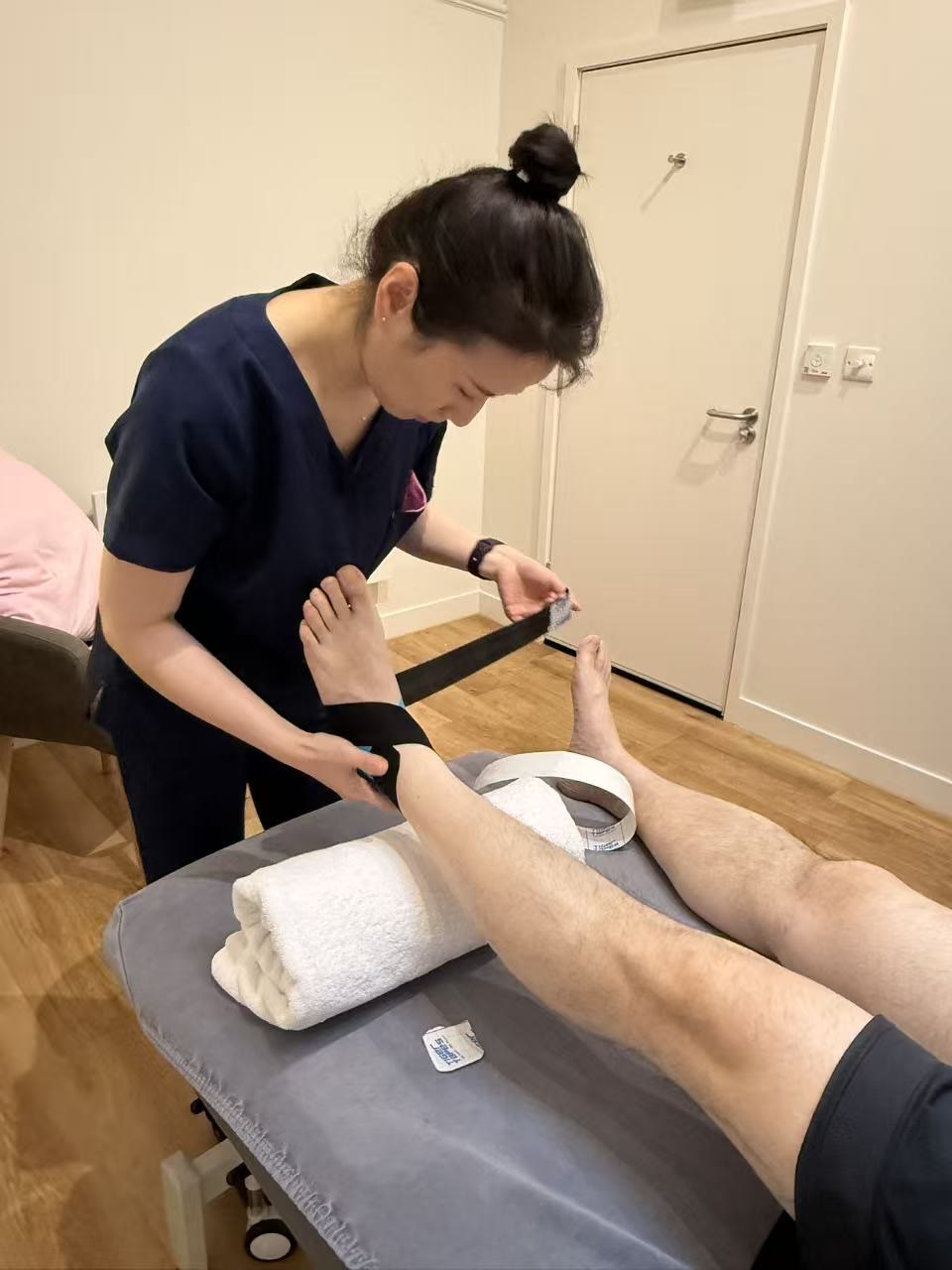
Rehabbing an ankle properly
The assessment covers the ligaments, dorsiflexion range, peroneal strength and, crucially, single-leg balance measured against the other side.
- Ligament testing and, in acute cases, applying the Ottawa Ankle Rules to decide on imaging
- Dorsiflexion range and single-leg balance measured on both sides and recorded
- Joint mobilisation to restore the dorsiflexion commonly lost after a sprain
- Soft tissue work through the calf and peroneals, with manual lymphatic drainage where swelling persists
- Sports taping for the return-to-sport phase
- A progressive balance and strength programme through to hopping and change of direction
A straightforward sprain often needs three or four sessions. Chronic instability, where the ankle has been rolling repeatedly for years, needs a longer run, typically six to eight sessions over two to three months, because the deficits have had time to embed.
When to get it checked
Get an acute sprain assessed within the first few days if you cannot put weight through it, if there is bruising and swelling within an hour, or if there is bony tenderness. Book an assessment at any point if an old ankle keeps giving way, since that is the pattern that responds well and rarely resolves on its own.
See a doctor or go to A&E if
- Inability to weight-bear for four steps immediately after the injury and in the clinic
- Bony tenderness over the back edge or tip of either ankle bone, or over the navicular or fifth metatarsal
- An obviously deformed ankle, which needs emergency assessment
- Numbness, a cold foot, or loss of pulse in the foot
- Severe swelling and bruising appearing within the first hour
Common questions
Do I need an x-ray?
The Ottawa Ankle Rules answer this reliably. An x-ray is indicated if you cannot take four steps immediately after the injury and in the clinic, or if there is bone tenderness at specific points on the ankle bones, the navicular or the base of the fifth metatarsal.
Without those findings, a fracture is very unlikely and imaging usually adds nothing.
My ankle stopped hurting weeks ago. Why does it keep rolling?
Because pain and stability recover on different timelines. The ligament injury also damages the receptors that tell your brain where the joint is, and that sense returns only with deliberate balance training.
This is the most common presentation we see for ankles, and it responds well even years later.
Should I wear a brace permanently?
Bracing or taping reduces re-injury risk during the return-to-sport period and through the first season back, which is where it earns its place.
Long-term reliance is worth avoiding, since the aim is for the ankle itself to do the job. Braces work best as a bridge while the balance work catches up.
Is it worth treating a sprain from years ago?
Yes, if it is still giving way, feels unreliable on uneven ground, or aches after long days. Those are signs of chronic ankle instability, and balance and strength training improves it regardless of how long ago the original injury was.
Left alone, chronic instability is associated with higher rates of later ankle joint problems, so it is worth addressing.